Alain Bindels
Feb 1, 2026
Artificial Intelligence is rapidly becoming a foundational force in the life sciences, transforming how we understand biology, discover drugs, and develop new therapies.
Artificial Intelligence is rapidly becoming a foundational force in the life sciences, transforming how we understand biology, discover drugs, and develop new therapies. Yet despite significant progress, the biotech industry remains constrained by structural inefficiencies, fragmented data ecosystems, and high failure rates that limit the speed and success of innovation.
Insights from Davos session: Where Biotech Meets AI
Artificial Intelligence is rapidly becoming a foundational force in the life sciences, transforming how we understand biology, discover drugs, and develop new therapies. Yet despite significant progress, the biotech industry remains constrained by structural inefficiencies, fragmented data ecosystems, and high failure rates that limit the speed and success of innovation.
This Insight Paper, produced following discussions at the Wealth & Family Office Forum – Davos Edition 2026, explores one of the most transformative questions in healthcare and investment today: How can the convergence of AI and biotechnology unlock faster, more precise, and more scalable approaches to drug discovery and development?
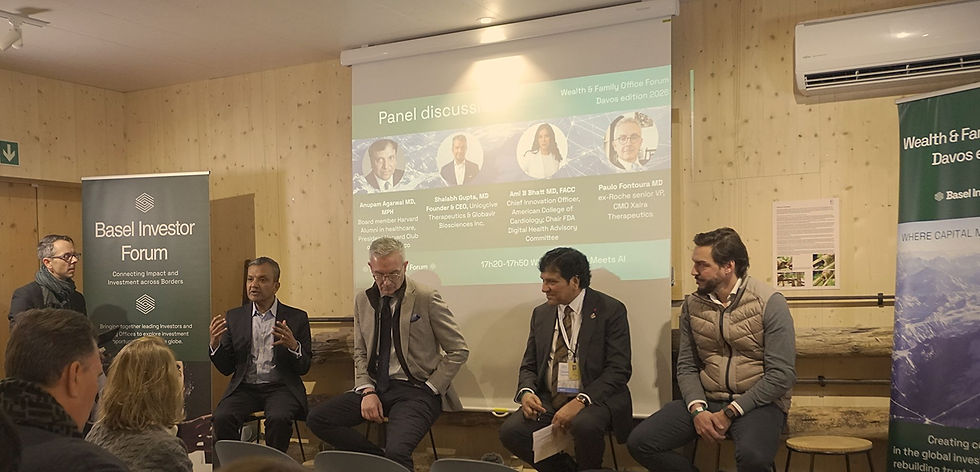
The panelists and contributors that participated in this session are:
Paulo Fontoura — Former Senior Vice President, Roche; Chief Medical Officer, Xaira Therapeutics
Anupam Agarwal, MD, MPH — Board Member, Harvard Alumni in Healthcare; President, Harvard Club of San Francisco
Shalabh Gupta, MD — Founder & CEO, Unicycive Therapeutics & Globavir Biosciences Inc.
Ami B. Bhatt, MD, FACC — Chief Innovation Officer, American College of Cardiology; Chair, FDA Digital Health Advisory Committee
Ricardo Gaminha Pacheco, MD — Senior Director BD&L, Insilico Medicine
Drawing on perspectives from biotech executives, clinicians, investors, and AI innovators, the paper examines the deep structural challenges of drug development—where up to 95% of projects fail, timelines extend beyond a decade, and costs reach billions per successful therapy.
It highlights how AI is evolving from a productivity tool into a core scientific infrastructure, enabling in silico experimentation, multi-omics integration, and generative approaches to molecule design. These advances are already reshaping how targets are identified, drugs are designed, and clinical trials are conducted.
The report also explores critical themes such as patient heterogeneity, precision medicine, AI-driven pharmacovigilance, and the emergence of agentic AI systems capable of orchestrating complex research workflows. At the same time, it underscores key challenges around data quality, interoperability, regulatory frameworks, and organizational transformation.
The paper concludes that the convergence of biotech and AI is not incremental—it represents a paradigm shift in how medicine is discovered, developed, and delivered. For investors, this creates a powerful long-term opportunity, but one that requires a deep understanding of data infrastructure, platform scalability, and scientific validation.
The report outlines concrete recommendations for investors, biotech leaders, and policymakers to harness AI responsibly while accelerating innovation, improving patient outcomes, and building more efficient and resilient healthcare systems.
👉 Download the full Insights Paper by registering below.